
George Foreman Net Worth: The Complete Story of a Boxing Legend’s Billion-Dollar Journey From Poverty to Prosperity

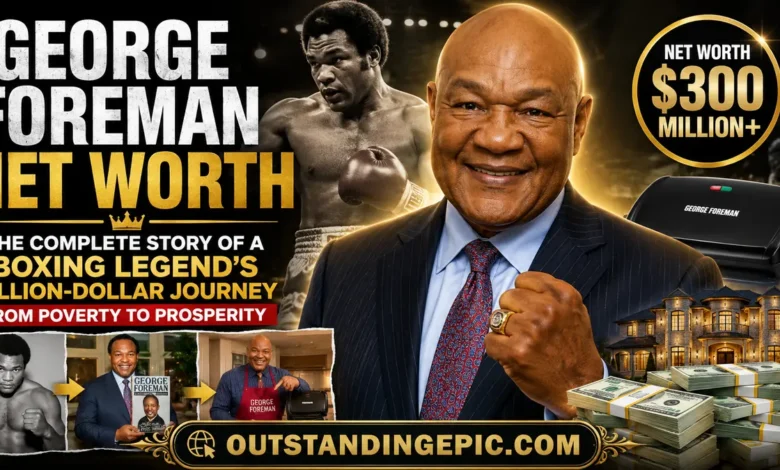
There are few stories in American history quite as extraordinary as George Foreman’s. A man born into crushing poverty in Marshall, Texas, who rose to become one of the most feared heavyweight champions in boxing history — and then, against every expectation, reinvented himself decades later into a household name worth hundreds of millions of dollars. The George Foreman net worth story isn’t just about money. It’s about resilience, reinvention, and what happens when a person refuses to let one chapter define their entire life.

Most people know George Foreman the boxer. Some remember the intimidating giant who knocked out Joe Frazier six times in two rounds in 1973. Others recall the mythical “Rumble in the Jungle” against Muhammad Ali in Kinshasa, Zaire. But the George Foreman who truly captured mainstream America’s heart and wallet wasn’t the fearsome young champion — it was the jovial, grinning, deeply relatable middle-aged man who came back to boxing at 45, reclaimed the heavyweight title, and then sold a countertop grill to virtually every household on the planet. That grill alone changed everything.
Understanding the full scope of George Foreman’s financial journey requires looking at each major chapter of his life — the early boxing career, the spiritual awakening that nearly derailed him financially, the legendary comeback, and of course, the George Foreman Grill deal that became one of the most lucrative celebrity endorsements in commercial history.
Who Is George Foreman? A Brief But Necessary Background
George Edward Foreman was born on January 10, 1949, in Marshall, Texas. He was the fifth of seven children, raised in poverty severe enough that he dropped out of school and spent his early teenage years involved in street crime. By his own account, he was heading nowhere fast — until a Job Corps program introduced him to boxing, and a trainer named Dick Saddler eventually shaped him into an Olympic champion.
Foreman won the gold medal at the 1968 Mexico City Olympics in the heavyweight division, famously waving a small American flag in the ring at a time of significant political tension surrounding the Games. That moment of patriotism launched him into public consciousness. He turned professional shortly after, and within five years had bulldozed through heavyweight boxing with a ferocity that made even seasoned observers uneasy. His punching power was considered historic. Opponents didn’t just lose — they often crumbled.
But Foreman’s first act as a public figure ended in 1977, following a loss to Jimmy Young that triggered what he later described as a profound near-death religious experience. He walked away from boxing, became an ordained minister, and spent a decade focused entirely on his church and community outreach in Houston. During that period, he made virtually no income from boxing and spent generously on charity work and his congregation. This is a critical context for anyone trying to understand the George Foreman net worth trajectory — because this wasn’t a man who carefully preserved his boxing earnings. He gave much of it away and lived modestly during his spiritual decade.
George Foreman Net Worth: The Current Estimate and What It Actually Means
As of 2025, George Foreman net worth is widely estimated at around $300 million. Some financial outlets have placed the figure slightly higher, closer to $320 million, while others are more conservative at $250 million. The variation depends heavily on how one accounts for the grill royalty income, real estate holdings, residual endorsement payments, and other business ventures that are not fully disclosed publicly.
What’s clear is that the vast majority of this wealth did not come from boxing. Even accounting for inflation, Foreman’s combined purses from both his first and second career as a professional boxer amount to roughly $60 to $70 million in today’s dollars — significant, certainly, but not in the same stratosphere as his business income. The George Foreman Grill licensing deal alone, which we’ll examine in depth later, generated somewhere between $200 and $250 million for Foreman personally over its lifetime. That one product transformed him from a wealthy former athlete into a genuinely elite business figure.
It’s also worth noting that Foreman’s financial profile is unusual in the world of sports. Many athletes of his generation — and even many who came after — struggled with financial mismanagement, predatory advisors, and the sudden loss of income that follows retirement. Foreman’s story runs almost entirely counter to that narrative, which is part of what makes it so compelling to study.
The First Boxing Career: Earnings, Purses, and Financial Reality
George Foreman’s first run as a professional boxer lasted from 1969 to 1977. During that period, he compiled a record of 45 wins and 2 losses, including his 1973 heavyweight title victory over Joe Frazier and the iconic 1974 “Rumble in the Jungle” loss to Muhammad Ali — one of the most watched sporting events in television history.
The Ali fight, despite being a loss, was one of the most significant paydays of Foreman’s early career. Both fighters reportedly earned $5 million each for that bout, largely funded by Zairean dictator Mobutu Sese Seko as part of an effort to bring international prestige to his country. In 1974 terms, $5 million was an extraordinary sum — roughly equivalent to $30 to $35 million today. That single fight remains one of the largest purses Foreman received in his first career.
His other major fights during this period generated respectable but not always spectacular paydays by modern standards. The era of nine-figure boxing payouts was still decades away. Promoters like Don King controlled much of the financial flow, and fighters often saw less of the actual gate revenue than their contracts suggested. Foreman himself has been candid in interviews about not fully understanding the financial structures of his early contracts.
By the time he retired in 1977, Foreman had certainly earned enough to live comfortably — but his years as a minister, combined with generous charitable giving, meant that the financial cushion was significantly thinner than it might have been. When he announced his comeback in 1987 at age 38, part of the motivation was genuinely financial. He needed money to fund his youth center and community programs in Houston.
The Comeback That Changed Everything
George Foreman’s return to boxing, which began in 1987 and culminated in his 1994 heavyweight championship victory, is one of the most improbable and emotionally resonant stories in sports history. He was 45 years old when he knocked out Michael Moorer to reclaim the WBA and IBF heavyweight titles — becoming the oldest heavyweight champion in history, a record that still stands.
From a purely financial standpoint, the comeback was already paying off before that iconic night. Foreman had completely transformed his public image during his years away. The menacing giant of the 1970s had become a warm, funny, likable personality who spoke openly about faith, family, and second chances. Television audiences loved him. HBO and the networks that broadcast his fights gained strong ratings. And corporate America began to take notice.
His fight against Evander Holyfield in 1991 generated a $12.5 million purse for Foreman — already a dramatic increase over his 1970s earnings and a sign of how much the boxing market had grown. The Moorer fight in 1994, though it didn’t produce the largest purse of his comeback, delivered something far more valuable: credibility, cultural relevance, and a wave of media attention that made George Foreman the most talked-about athlete in America.
It was during this period that a small company called Salton, Inc. approached him about endorsing a countertop electric grill. The rest, as they say, is history — but the specifics of how that deal evolved and what it ultimately produced deserve a closer look, because they represent the single most important financial event in George Foreman’s life.
The George Foreman Grill: A Business Masterclass in Celebrity Licensing
The George Foreman Lean Mean Fat-Reducing Grilling Machine — most people just call it the George Foreman Grill — was introduced in 1994 and became one of the best-selling kitchen appliances in American history. But understanding how Foreman came to be associated with it, and what he actually earned, requires separating mythology from documented reality.
Initially, Foreman was offered a standard celebrity endorsement deal — upfront payments in exchange for the use of his name and likeness. The original arrangement reportedly paid him around $137,500 per year. Not nothing, but hardly life-changing money for a former heavyweight champion. What changed everything was the restructuring of the deal as the product began to explode in popularity.
As the grill became a cultural phenomenon throughout the late 1990s, selling millions of units annually through infomercials, retail chains, and eventually global distribution, Salton renegotiated with Foreman. He transitioned from a flat endorsement fee to a royalty arrangement — reportedly earning between 40 and 45 percent of the profits from every grill sold. This was a staggering percentage, and it reflected how essential Foreman’s personality and credibility had become to the product’s success.
By 1999, the grill was generating over $350 million in annual sales. Foreman’s royalty income was climbing into the tens of millions of dollars per year. Then, in 1999, Salton offered him a buyout of his royalty interest: a lump sum payment of $137.5 million to surrender all future royalty claims. Foreman accepted. In one transaction, he received more money than most professional athletes earn in an entire career. When you factor in what he had already earned through the royalty arrangement before the buyout, total income from the grill is estimated at somewhere between $200 and $250 million.
To put this in perspective: the George Foreman Grill has sold over 100 million units worldwide since its launch. It remains one of the top-selling small kitchen appliances ever produced. Foreman’s connection to it is so thorough that most consumers forget it was originally a product that simply needed a famous face. The “fat reducing” angle, pitched specifically at health-conscious consumers in the mid-1990s, was ideally timed. And Foreman, who spoke enthusiastically about the grill and actually used it, brought an authenticity that pure paid advertising rarely achieves.
Breaking Down George Foreman’s Income Sources
To fully understand the George Foreman net worth picture, it helps to look at the individual pillars that have contributed to his wealth over the decades.
| Income Source | Estimated Earnings | Notes |
|---|---|---|
| Boxing Career (1969–1977) | ~$12–15M (nominal) | Adjusted for inflation, closer to $50–60M today |
| Boxing Comeback (1987–1997) | ~$25–30M | Includes Holyfield, Moorer, and other major bouts |
| George Foreman Grill Royalties | ~$60–80M (before buyout) | Earned over approximately 5 years |
| Grill Royalty Buyout (1999) | $137.5M | Lump sum from Salton, Inc. |
| TV, Endorsements & Media | ~$20–30M | NBC commentary, other brand deals |
| Books and Personal Brand | ~$5–10M | Multiple published titles |
| Real Estate & Investments | Undisclosed | Significant Texas real estate holdings |
These figures, while approximate, illustrate something important: boxing — the thing George Foreman is most famous for — accounts for a minority of his total lifetime earnings. The grill alone likely represents 60 to 70 percent of his net worth. This makes Foreman’s financial story genuinely unusual in the world of sports, where the primary athletic career almost always dominates earnings.
Television, Media, and the Power of Personality
One underappreciated pillar of the George Foreman financial story is his television career. During his boxing comeback and in the years that followed, Foreman became a beloved media personality. He served as a color commentator for HBO boxing broadcasts, bringing humor, warmth, and genuine expertise to the role. His commentary work, combined with guest appearances across virtually every major talk show of the 1990s and 2000s, kept him perpetually visible to the American public.
Foreman also appeared in numerous commercials beyond the grill, lending his name and face to brands that valued his wholesome, trustworthy image. He endorsed everything from Doritos to meat patties to household products. None of these individual deals matched the grill royalties, but collectively they added tens of millions of dollars over the years and — perhaps more importantly — maintained the public goodwill that made his name commercially valuable in the first place.
He has also published multiple books, including his autobiography “By George: The Autobiography of George Foreman” and several motivational and faith-based titles. These added modestly to his income but meaningfully to his brand, helping cement his image as a figure of wisdom and resilience rather than simply a retired athlete.
Real Estate and Long-Term Investments
While George Foreman has been somewhat private about his investment portfolio, it is widely known that he has made substantial real estate investments, particularly in Texas. He has owned multiple properties in the Houston area over the decades, and real estate has long been a favored wealth preservation tool for high-net-worth individuals looking to move beyond volatile or celebrity-dependent income streams.
The timing of his major liquidity event — the $137.5 million buyout in 1999 — coincided with a period of significant real estate opportunity. Whether Foreman captured that opportunity aggressively or moved more conservatively into stable asset classes is not publicly documented in detail. What is known is that he has not made the kinds of headline-grabbing financial mistakes that have dogged so many other former champions. He hasn’t filed for bankruptcy, hasn’t been the subject of major financial fraud allegations, and hasn’t needed to return to the spotlight out of financial desperation.
This matters because the story of boxing’s relationship with wealth is often a tragic one. Mike Tyson famously earned over $400 million and went bankrupt. Evander Holyfield, who fought Foreman, also faced serious financial difficulties in retirement. Oscar De La Hoya had well-publicized struggles. The list goes on. Foreman’s financial management, while not perfectly documented, appears to have been significantly more prudent than many of his contemporaries.
Family, Faith, and Financial Philosophy
George Foreman has been married five times and has twelve children — ten sons and two daughters. He famously named five of his sons George Edward Foreman (the second through the sixth), explaining that he wanted each of them to carry his name as a reminder of where they came from. His daughter Freeda Foreman also pursued boxing professionally before her tragic death in 2019, a loss that Foreman has spoken about with deep sorrow.
Supporting a large family across multiple decades requires significant ongoing financial resources, and Foreman has been open about the fact that his family obligations are substantial. His approach to money, however, appears deeply influenced by his faith. He has spoken frequently about viewing wealth as a tool for helping others rather than as an end in itself — a philosophy forged during his decade as a minister when he essentially walked away from financial ambition entirely.
“I never saw money as the goal,” Foreman has said in various interviews. “The goal was always something bigger. Money just helped me do bigger things.”
This perspective, whether one agrees with it or not, appears to have given Foreman a healthier relationship with wealth than many athletes of his era. He didn’t chase money desperately when he had it, and he didn’t collapse into recklessness when it was abundant. There is something genuinely instructive in that balance for anyone thinking about long-term financial stability.
George Foreman vs. Other Boxing Legends: A Net Worth Comparison
To properly contextualize the George Foreman net worth figure, it helps to compare him with other boxing legends of his era and beyond.
Floyd Mayweather Jr., widely considered the richest active boxer in history, has earned upwards of $1 billion in career fight purses alone — though his net worth has fluctuated due to his famously lavish spending habits. Manny Pacquiao, another all-time great, has accumulated significant wealth but has also directed large amounts toward politics and philanthropy in the Philippines. Sugar Ray Leonard, who overlapped partially with Foreman’s career, has a net worth estimated around $120 million.
Among the heavyweights of Foreman’s specific era, he stands out clearly. Muhammad Ali’s net worth at the time of his death in 2016 was estimated at approximately $80 million — a fraction of Foreman’s, despite Ali being the more globally iconic figure. Joe Frazier, who Foreman famously destroyed in Kingston, Jamaica in 1973, died with a considerably more modest estate. Even Larry Holmes, who held the heavyweight title for seven years, is estimated at around $20 to $30 million.
What separates Foreman isn’t boxing success — Ali was more celebrated, Holmes held the title longer, Tyson earned more in pure fight purses. What separates him is the business chapter. No other boxing legend of his generation has anything comparable to the grill deal in their financial biography. It’s a genuinely singular achievement in the intersection of sports celebrity and commercial licensing.
The Spiritual Decade: What It Reveals About Foreman’s Character
The decade between 1977 and 1987, when George Foreman walked away from boxing and devoted himself entirely to ministry, is easy to overlook when telling his wealth story — but it’s actually deeply revealing. During those years, he founded the George Foreman Youth and Community Center in Houston’s Humble, Texas, area and dedicated enormous energy and personal resources to keeping at-risk youth off the streets.
He has stated in interviews that he was sometimes so financially stretched during this period that he seriously considered going back to boxing simply to raise money for the center. The decision to return wasn’t primarily driven by ego or competitive fire — it was driven by a genuine need to fund work he considered sacred.
This context reframes everything that came after. The comeback wasn’t about glory-chasing. The grill deal wasn’t about greed. The media appearances weren’t about vanity. Each chapter, when Foreman tells it, was about sustaining the ability to do meaningful work and support the people who depended on him. Whether or not one accepts that framing entirely, it explains the consistency and authenticity that made his public persona so commercially powerful. Audiences trusted him because he seemed to mean what he said — and by most accounts, he actually did.
Legal and Business Controversies: An Honest Assessment
No financial biography of this scale would be complete without acknowledging the complications. George Foreman has faced some legal and business disputes over the years, though none have significantly dented his wealth or reputation.
Most notably, he has been involved in litigation related to the use of his name in various commercial contexts, as often happens with celebrities whose names carry significant commercial value. There have also been questions raised over the years about the licensing terms of the grill deal and whether Foreman received all the compensation he was entitled to at various stages.
He also faced personal controversy in 2023, when multiple women publicly accused him of sexual abuse that allegedly occurred decades earlier. Foreman denied the allegations. The situation generated significant media attention and raised difficult questions. It did not, at the time of writing, result in criminal charges or civil judgments that have been publicly adjudicated.
These complications are part of the complete picture and deserve acknowledgment even in an article primarily focused on financial history.
What the George Foreman Story Teaches About Wealth Building
For anyone interested in wealth creation, the George Foreman net worth story offers several genuinely useful lessons — not as motivational platitudes, but as documented observations about how his particular financial trajectory unfolded.
The first and most important lesson is that the biggest financial opportunities often arrive well after the primary career has peaked. Foreman was in his mid-40s when the grill deal came together. His peak earning potential as a boxer had passed more than a decade earlier. If he had defined his commercial value solely by his athletic prime, he would have missed the biggest paycheck of his life entirely.
The second lesson is about the structure of deals. The transition from flat endorsement fee to royalty percentage was the pivotal moment in Foreman’s financial life. Royalties, when the underlying product succeeds, create compounding income streams that far exceed any upfront payment. This is a principle understood well in the music industry, in publishing, and in certain corners of the business world — but it’s less commonly applied in celebrity endorsements. Foreman’s deal, whether by design or fortunate renegotiation, captured this principle perfectly.
The third lesson is about longevity. Foreman’s commercial value depended entirely on his continued public relevance, which in turn depended on his continued visibility, authenticity, and likability. He maintained all three for decades by staying genuinely engaged with the public, being honest about his personal story including its failures and contradictions, and never projecting an image so polished that it felt manufactured.
George Foreman in His Later Years: Legacy and Current Status
Now in his mid-70s, George Foreman has largely stepped back from active commercial work, though his name and grill brand continue generating revenue in his absence. He remains a beloved public figure, frequently referenced in sports history discussions and occasionally appearing in documentaries or anniversary coverage of iconic boxing events.
His legacy in boxing is secure: two-time heavyweight champion, Olympic gold medalist, Hall of Fame inductee, and one of the hardest punchers the sport has ever seen. But his legacy in American commercial culture may be even larger. The George Foreman Grill changed the countertop appliance market, helped mainstream the concept of at-home healthy cooking, and demonstrated the power of authentic celebrity endorsement in ways that marketing textbooks have studied for decades.
In terms of philanthropy, Foreman has continued supporting youth programs and community initiatives throughout his life. The George Foreman Youth and Community Center remains active. He has spoken at length about the importance of giving young people, particularly those from backgrounds like his own, a legitimate path forward.
The George Foreman net worth of approximately $300 million is the headline figure — but the full richness of his financial story is found in the details of how it was built, preserved, and given meaning through the work it funded.
Conclusion: A Story That Defies Every Expectation
George Foreman’s financial journey is, at its core, a story about defying expectation at every turn. A kid from poverty who became a champion. A champion who became a minister. A minister who became a champion again. A champion who became a household name not through fighting but through grilling. The George Foreman net worth of around $300 million is extraordinary not just in its size but in the path that led there — a path characterized by failure, reinvention, faith, humor, and an almost accidental genius for being exactly what the moment needed.
What makes this story resonate beyond the sports world is its fundamental accessibility. Foreman isn’t celebrated because he was superhuman — he’s celebrated because he was deeply, stubbornly human. He lost the biggest fight of his first career. He walked away from money. He came back when most people thought it was embarrassing to do so. And then he made more money than most athletes ever dreamed of by selling a kitchen appliance with the same enthusiasm he once brought to punching people in the face.
If there’s a lesson in any of that for the rest of us, it might simply be this: the chapter you’re in right now is never the last chapter. And sometimes, the best opportunities arrive precisely when you’ve stopped expecting them.
FAQs
What is George Foreman’s net worth in 2025?
Around $300 million, mostly from the George Foreman Grill deal, not boxing.
How much did he make from the grill?
An estimated $200–250 million total, including a $137.5 million buyout from Salton Inc. in 1999.
How did he become a two-time champion?
Won the title in 1973, lost it to Ali in 1974, then shockingly reclaimed it in 1994 at age 45 by knocking out Michael Moorer.
Did George Foreman ever go broke?
No. Unlike many boxing legends, he never filed for bankruptcy and managed his wealth wisely.
What other endorsements did he have?
HBO boxing commentary, Doritos commercials, published books, and various brand deals — though nothing came close to the grill.
How many kids does he have?
Twelve — including five sons all named George Foreman.
Latest Insights for You: [OutstandingEpic]

OutstandingEpic Editorial Team is an independent digital publishing unit focused on delivering high-quality, insight-driven content across technology, business, health, gaming, sports, and home improvement.
Rather than following generic reporting, the team combines data-backed research, market observations, and real-world analysis to break down complex topics into practical, easy-to-understand insights. From emerging crypto trends and digital innovations to everyday lifestyle improvements, every piece of content is crafted with clarity, accuracy, and reader value in mind.
The team’s approach is centered on relevance and usability—ensuring that readers not only stay informed but also gain actionable knowledge they can apply in real scenarios. By continuously tracking industry shifts and evolving online trends, OutstandingEpic Editorial Team maintains a consistent standard of trustworthy and up-to-date content.
Expertise: Data-Driven Insights, Crypto & Market Trends, Digital Strategy, Tech & Innovation
Coverage: Technology, Business, Health, Gaming, Sports, Home Improvement
Approach: Research-Based, Practical, and User-Focused Content
Updated: April 2026