


Discover the 2026 BMW 7 Series — specs, pricing, powertrain options, tech features, and how it stacks up against rivals. The definitive guide to BMW’s flagship sedan.


The 2026 BMW 7 Series is not just a car. It is a rolling statement — a declaration that luxury, technology, and driving pleasure do not have to be at odds with each other. In a segment where most competitors are content to polish their existing formula, the 2026 BMW 7 Series arrives with a quietly confident sense of purpose that makes rivals look like they are standing still. Whether you are looking at the inline-six 740i, the plug-in hybrid 750e, the V8-powered 760i, or the fully electric i7, BMW has built a flagship that covers every possible base without losing sight of what makes this car special.
What sets this generation apart — known internally as the G70 — is that it was never built just to impress on a spec sheet. Every detail, from the ergonomics of the driver’s seat to the way the rear cabin wraps around passengers like a business-class flight cabin, has been engineered with real-world use in mind. The 2026 BMW 7 Series builds on the strong foundation laid by the 2023 generation, adds meaningful refinements, and positions itself perfectly just before the major facelift expected in 2027. In short, if you want the mature, fully resolved version of this generation at its absolute best, this is the moment.
What Is New for the 2026 BMW 7 Series
The 2026 BMW 7 Series does not arrive with a dramatic overhaul, and honestly, it does not need one. This model year represents a carefully considered evolution of the G70 platform, incorporating the most relevant updates without disrupting what was already working brilliantly. BMW’s philosophy here is deliberate refinement — taking something great and making it just a little better.
One of the most notable additions is the fully digital key function. This feature allows drivers to use their smartphone as the vehicle’s key, replacing the traditional physical fob for day-to-day use while still retaining the high-quality physical key as a backup. It sounds like a minor convenience, but once you have used it, going back feels archaic. On the other side of the update sheet, BMW has discontinued the gesture control system — a feature that, while novel, was rarely used and often misread inputs. Its removal actually simplifies the in-car experience and makes the interior feel more intentional. Pricing across the lineup has been adjusted modestly upward, reflecting both inflation and the addition of this new tech, with the base 740i now starting at around $99,300 in the United States.
2026 BMW 7 Series Powertrain Options — Something for Every Driver
One of the biggest strengths of the 2026 BMW 7 Series lineup is just how broad and genuinely useful the powertrain range is. Whether you commute mostly in the city, tackle long interstate hauls, or want the most effortless performance possible, there is a variant that fits. BMW has not forced buyers into a one-size-fits-all solution, and the result is a lineup that feels thoughtfully curated rather than arbitrarily assembled.
Here is how the powertrain family breaks down:
| Model | Engine | Power Output | 0–60 mph | Drivetrain | Starting Price (US) |
|---|---|---|---|---|---|
| 740i | 3.0L Inline-6 TwinPower Turbo + 48V mild hybrid | 375 hp | 5.2 sec | RWD | ~$99,300 |
| 740i xDrive | 3.0L Inline-6 TwinPower Turbo + 48V mild hybrid | 375 hp | 4.9 sec | AWD | ~$102,300 |
| 750e xDrive | 3.0L Inline-6 + Electric Motor (PHEV) | 483 hp | 4.6 sec | AWD | ~$110,000 |
| 760i xDrive | 4.4L V8 TwinPower Turbo + 48V mild hybrid | 536 hp | 4.1 sec | AWD | ~$124,700 |
The entry point, the 740i, is powered by BMW’s legendary B58 inline-six engine that produces 375 horsepower with the help of a 48-volt mild-hybrid system. It is genuinely quick, refined, and efficient — returning an EPA-estimated 25 mpg city and 31 mpg highway in rear-wheel-drive configuration. For most buyers, this powertrain alone justifies the price of admission. It revs smoothly, pairs beautifully with the eight-speed ZF automatic transmission, and never feels underpowered, even when you have a full complement of rear-seat passengers.
The 750e xDrive is the sweet spot for many buyers, combining the inline-six with an electric motor for a combined output of 483 horsepower and more than 30 miles of pure electric range. For company car buyers, particularly in the UK and Europe, the tax implications of the PHEV variant make it an easy recommendation. In the United States, this is the model for executives who want strong performance and the ability to commute on electricity alone during the week. BMW has done an admirable job integrating the electric and combustion powertrains, though some reviewers note the transitions between the two are not quite as seamless as in the best-in-class hybrid systems.
At the top of the combustion range sits the 760i xDrive with its twin-turbocharged 4.4-liter V8 producing 536 horsepower. This machine reaches 60 mph in 4.1 seconds — quick enough to humble sports cars at a stoplight — while still riding with the silky composure you expect from a luxury flagship. The V8 note is subdued but distinctly satisfying, and for buyers who simply want the most powerful internal combustion version available, this is the one. Just be aware that the V8’s fuel economy is considerably less flattering: an EPA-estimated 18 mpg city and 25 mpg highway.
2026 BMW 7 Series Design — Bold, Polarizing, and Unmistakably Premium
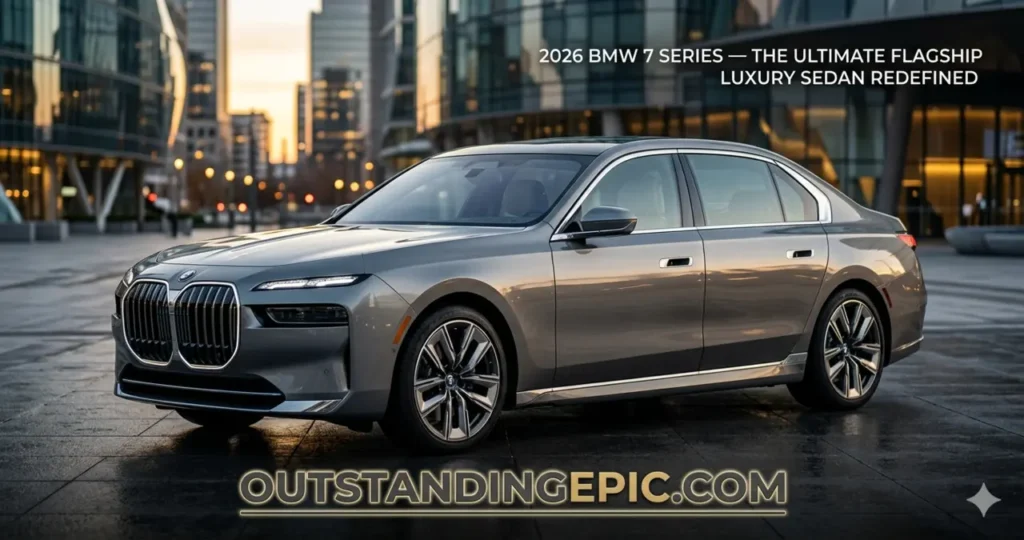
The exterior of the 2026 BMW 7 Series is one of the most talked-about aspects of this generation, and it divides opinion in the most entertaining way. BMW made a deliberate decision to go big — literally — with the kidney grille, stretching it to proportions that turn heads whether you want them to or not. The massive grille is framed by L-shaped LED headlights that give the front end a distinctive and assertive face that is instantly recognizable at night. Optional crystal headlights add another layer of visual sophistication, catching light in a way that feels more like jewelry than automotive hardware.
The rest of the exterior is a masterclass in restrained confidence. The flowing three-box silhouette is clean and proportionate despite the car’s generous dimensions — the 2026 BMW 7 Series measures 212.2 inches long, 76.8 inches wide, and 60.8 inches tall. The shoulder line runs uninterrupted from front to rear, and the concealed exhaust tips keep the rear end looking clean and sophisticated rather than shouty. The optional illuminated kidney grille is a polarizing but genuinely impressive touch — pulsing with light in the dark, it makes parking lots feel like entrances to important events. Available black window trim sharpens the silhouette further, and the overall effect is of a car that knows exactly what it is.
“The 2026 BMW 7 Series does not ask for attention — it simply commands it.”
The Interior — A Sanctuary on Wheels
Step inside the 2026 BMW 7 Series and the first word that comes to mind is sanctuary. This interior does not just look good — it feels considered, purposeful, and deeply luxurious in a way that goes beyond expensive materials. The standard Veganza upholstery is a high-grade vegan leather that holds its own against genuine hide, and if you want the real thing, BMW offers Extended Merino leather as an upgrade. Every touchpoint — the door pulls, the climate controls, the gear selector area — is finished to a standard that justifies the price tag.
The driver faces a 14.9-inch curved touchscreen running BMW’s iDrive 8.5 operating system, paired with a 12.3-inch digital instrument cluster. The system supports Apple CarPlay and Android Auto, and a standard head-up display projects key information onto the windshield. The Interaction Bar — a crystalline strip running across the dashboard — pulses with color to indicate drive modes and incoming calls, blending ambient design with actual functionality in a way that feels genuinely clever rather than gimmicky.
Space is generous throughout, with the rear cabin in particular offering what BMW describes as lounge-like proportions. The optional Executive Lounge Seating package allows rear passengers to recline at significant angles with extendable leg rests, turning the back seat of the 2026 BMW 7 Series into something approaching a business-class aircraft seat. Quad-zone automatic climate control, heated rear seats, and rear door touchscreens for controlling entertainment and climate complete the picture. The trunk offers 19 cubic feet of space — more than the Mercedes-Benz S-Class and Audi A8, making it one of the more practical flagships in the segment.
The BMW Theater Screen — Redefining Rear-Seat Entertainment
If there is one feature that makes the 2026 BMW 7 Series stand out from every other luxury sedan on the market, it is the optional BMW Theater Screen. This is not a pair of headrest-mounted tablets — it is a 31.3-inch, 8K ultra-wide display that descends from the roofline to span nearly the full width of the cabin. The effect is genuinely cinematic. When you are sitting in the rear of the 2026 BMW 7 Series with this screen deployed, you are not in a car — you are in a private screening room with wheels.
The Theater Screen runs Amazon Fire TV natively and uses the vehicle’s 5G personal eSIM for connectivity. That means Netflix, Prime Video, Disney+, Hulu, and YouTube are all available without needing to mirror a phone. BMW has also added an HDMI port, meaning you can connect a gaming console and play directly on the screen — a feature that has generated genuine excitement among early reviewers. Rear passengers control the screen, their seat settings, and the cabin climate through 5.5-inch touchscreens built into each rear door. The optional Bowers & Wilkins Diamond sound system with 35 speakers and 4D audio transducers embedded in the seatbacks completes the experience, letting passengers feel bass frequencies as well as hear them.
“When the Theater Screen descends and the lights dim, the BMW 7 Series stops being a car and starts being an experience.”
For families, the Theater Screen turns long road trips into something children actually look forward to. For executives, it is a flying office — the built-in camera supports high-definition video conferencing, so a Zoom call with Tokyo is perfectly achievable while cruising the interstate. It is one of those features that sounds extravagant until you use it once, at which point it immediately becomes indispensable.
2026 BMW 7 Series Technology and Driver Assistance
The technology package in the 2026 BMW 7 Series is comprehensive enough to make the head of any tech team envious. Standard equipment includes rear and top-view cameras, blind spot monitoring, lane-keeping assist, and rear cross-traffic alert. The $1,750 Premium Package adds surround view cameras, self-parking capability, and adaptive cruise control with Stop & Go functionality — genuinely one of the best value-add packages in the segment, because most drivers will use every single one of those features on a weekly basis.
For those who want the full semi-autonomous experience, BMW’s Driving Assistance Pro system offers hands-free highway driving and automatic lane changes for an additional $2,500. The system uses AI to monitor traffic conditions multiple car lengths ahead, delivering subtle braking pulses to warn the driver of hazards before they become visible to the naked eye. It is advanced, confidence-inspiring, and — importantly — it keeps the driver genuinely engaged rather than creating a passive experience that breeds complacency.
BMW ConnectedDrive integrates the car with mobile devices, smart home systems, and cloud-based services seamlessly. Over-the-air software updates mean the 2026 BMW 7 Series gets smarter over time without requiring a dealer visit. The digital key function — new for this model year — allows the smartphone to serve as the primary access method, with keyless entry and start handled entirely through a Bluetooth and Ultra-Wideband connection. The optional illuminated kidney grille can be set to pulse in sync with the ambient lighting, creating a welcome sequence that feels theatrical in the best possible way.
2026 BMW 7 Series Performance and Driving Dynamics
For a car that weighs over two tons, the 2026 BMW 7 Series handles with remarkable agility. The credit goes largely to the standard rear-axle steering system, which reduces the effective turning radius at low speeds and improves stability at highway speeds. The result is a car that feels smaller and more nimble than its footprint suggests — a trait that makes navigating tight city streets or multi-storey car parks far less stressful than you might expect.
The standard air suspension with adaptive dampers does an exceptional job of managing the dual mandate that all luxury flagships must meet: comfort and control. In Comfort mode, the ride is wonderfully hushed — small road imperfections are absorbed entirely, and only larger bumps register with the gentlest of reminders. Switch to Sport mode and the car tightens up noticeably without ever becoming harsh. The eight-speed ZF automatic transmission shifts with a smoothness that perfectly suits the car’s character, and in the 740i, the mild-hybrid system contributes a small but noticeable torque boost from low speeds that makes city driving feel effortlessly responsive.
The 760i xDrive is the performance highlight of the range, and its 536-horsepower V8 delivers acceleration that feels almost comically at odds with the car’s serene interior. The 0-60 sprint in 4.1 seconds is quick by any measure, and the V8’s sound — even through the sound insulation that surrounds the cabin — has a satisfying depth that the inline-six simply cannot replicate. This is a car that rewards the driver who occasionally wants to remember why they chose a BMW over a Bentley.
2026 BMW 7 Series vs. Mercedes-Benz S-Class vs. Audi A8
The luxury flagship segment has exactly three serious contenders, and the 2026 BMW 7 Series sits right in the middle of a genuinely fascinating three-way competition. Here is how they line up:
| Feature | 2026 BMW 7 Series | Mercedes-Benz S-Class | Audi A8 |
|---|---|---|---|
| Starting Price (US) | ~$99,300 | ~$120,000 | ~$90,000 |
| Engine Options | I6, PHEV, V8, Electric | I6, V8, PHEV, V8 bi-turbo | I6, V8 |
| Rear Entertainment | 31.3″ 8K Theater Screen | 11.6″ rear screens | 10.1″ rear screens |
| Electric Range (PHEV) | 30+ miles | ~20 miles | ~26 miles |
| Trunk Space | 19 cu ft | 12.8 cu ft | 13.3 cu ft |
| Driving Dynamics | Driver-focused | Comfort-focused | Balanced |
| Key Tech | iDrive 8.5, Theater Screen | MBUX, Energizing Comfort | MMI Touch |
The Mercedes-Benz S-Class remains the benchmark for traditional, old-world luxury. Its interior opulence, ride quality, and sense of occasion are exceptional, but it starts at roughly $20,000 more than the base 2026 BMW 7 Series and its rear entertainment technology is simply not in the same league. If you spend most of your time being driven rather than driving, the S-Class remains a compelling choice. But if you want cutting-edge technology, better driving engagement, and more trunk space, the BMW wins comfortably.
The Audi A8 is the most affordable of the three and offers a beautifully built interior, but it has fallen behind on technology and rear-seat spectacle. The lack of anything like the Theater Screen and less advanced driver assistance systems make it harder to recommend when the 2026 BMW 7 Series exists at a similar price point. For buyers who prioritize understated German elegance and strong residual values, the A8 has merit — but the BMW’s feature set is simply more compelling for the money.
The BMW i7 — The Electric Path Within the Family
No discussion of the 2026 BMW 7 Series lineup is complete without acknowledging the fully electric i7. Sharing the same body, platform, and interior as the combustion models, the i7 offers all the luxury of the 7 Series with zero tailpipe emissions. The i7 eDrive50 uses a single rear motor, while the i7 xDrive60 uses dual motors for all-wheel drive, and the i7 M70 flagship produces an extraordinary 660 horsepower.
The i7 M70 is worth its own paragraph. Priced at approximately $140,000, it is the fastest and most powerful BMW 7 Series ever made. It reaches 60 mph in under four seconds while delivering the same executive-class rear cabin experience as every other model in the range. The battery architecture supports DC fast charging at up to 250 kW, meaning that under optimal conditions, significant range can be added in a very short time. For buyers who want to experience the future of luxury mobility without compromising on any of the things that make the 7 Series special, the i7 is a genuinely remarkable product.
The electric range figures place the i7 comfortably within the top tier of the segment, and BMW’s ConnectedDrive integration means route planning around chargers is handled smoothly and intelligently. The only trade-off is slightly reduced trunk space compared to the combustion models due to battery packaging — but most buyers in this segment will find that a very acceptable compromise.
What It Is Like to Actually Live With the 2026 BMW 7 Series
There is a difference between a car that impresses on a test drive and a car that continues to impress on the daily commute, the school run, and the cross-country weekend trip. The 2026 BMW 7 Series is emphatically in the second category. The refinement of the G70 platform — now in its third model year — means all the rough edges that occasionally appeared in early reviews have been addressed, and what remains is a car of exceptional daily usability.
The 19 cubic feet of trunk space is genuinely useful — larger than both the S-Class and the A8 — making the 2026 BMW 7 Series a viable choice for families as well as executives. The rear cabin is large enough for adults of any height to ride comfortably, the four-zone climate control keeps everyone happy regardless of where they are sitting, and the optional heated rear seats add a layer of comfort that makes winter commutes genuinely pleasant. The Panoramic Sky Lounge LED roof floods the cabin with natural light during the day and creates a star-field ambiance at night — a feature that sounds unnecessary until you experience it, at which point it becomes quietly wonderful.
BMW covers the 2026 BMW 7 Series with a four-year, 50,000-mile basic warranty, and complimentary scheduled maintenance is included for the first three years or 36,000 miles. At this price point, that level of after-sales support is expected, but it is worth noting that BMW’s service network is extensive and the availability of parts is not an issue. The RepairPal reliability rating of three out of five reflects the complexity of the technology on offer, and buyers should factor in slightly higher-than-average ownership costs compared to simpler vehicles.
2026 BMW 7 Series — Trim Levels and Pricing Breakdown
Understanding the 2026 BMW 7 Series model lineup makes the buying process considerably simpler. Here is a clear overview:
| Trim / Model | Key Features | MSRP (US, approx.) |
|---|---|---|
| 740i | B58 inline-six, 375hp, 18-way power seats, 14.9″ display, quad-zone climate | ~$99,300 |
| 740i xDrive | All of the above plus AWD | ~$102,300 |
| 750e xDrive | PHEV, 483hp, 30+ mi EV range, extra standard equipment | ~$110,000 |
| 760i xDrive | V8, 536hp, additional luxury features as standard | ~$124,700 |
The base 740i is genuinely well-equipped. Standard items include heated front and rear seats, 18-way power-adjustable front seats, that 14.9-inch touchscreen, the 12.3-inch instrument cluster, and a standard head-up display. The $1,750 Premium Package is the most worthwhile addition at any trim level, adding surround view cameras, self-parking capability, adaptive cruise control with Stop & Go, and the illuminated kidney grille — features most buyers will use every single day.
Notable optional extras worth considering include the BMW Theater Screen, which is bundled with the rear executive lounge package; the Bowers & Wilkins Diamond audio system; the Panoramic Sky Lounge LED roof; automatic doors; and the Driving Assistance Pro system for hands-free highway capability. Building a fully loaded 760i xDrive with all the desirable options can push the transaction price well past $150,000, so it pays to be deliberate about which features genuinely matter to your lifestyle.
Should You Buy the 2026 BMW 7 Series Before the Next Generation Arrives?
This is the question that will be on every prospective buyer’s mind, given that a major facelift is expected in 2027. The honest answer is that the 2026 BMW 7 Series is an excellent buy precisely because it is a mature, fully resolved product. The G70 generation has had three model years to iron out any gremlins, and what remains is a car that delivers on its promises with consistency and confidence.
New-generation models always command a premium at launch, and they invariably arrive with first-year quirks that take time to resolve. The 2026 BMW 7 Series, by contrast, is known. Its strengths are well-documented, its weaknesses are understood and manageable, and dealers are experienced with its systems. For buyers who want the most refined and trusted version of this generation, the 2026 model year is arguably the sweet spot — all the benefit of a mature platform, none of the risk of being an early adopter.
If the prospect of the upcoming refresh is important to you, the right move is to wait for the full reveal. But if you want an outstanding luxury flagship today — one that delivers on every front and will continue to impress for years to come — the 2026 BMW 7 Series is a car you will be entirely happy with long after the next generation has arrived.
Conclusion
The 2026 BMW 7 Series is exactly what a flagship luxury sedan should be — commanding, technologically brilliant, effortlessly powerful, and deeply comfortable without sacrificing the driving character that has always set BMW apart. It handles the daily commute as gracefully as it handles a cross-country journey, and it impresses in the back seat just as much as it does behind the wheel. Yes, a new generation is coming. But the 2026 BMW 7 Series is no placeholder — it is the full realization of a generation, polished to a standard that very few cars at any price can match. For anyone stepping into the flagship luxury segment right now, this is where the conversation starts and, for many buyers, where it ends.
Frequently Asked Questions About the 2026 BMW 7 Series
Q: What is the starting price of the 2026 BMW 7 Series in the United States? A: The 2026 BMW 7 Series starts at approximately $99,300 for the rear-wheel-drive 740i. Adding all-wheel drive via xDrive raises this to around $102,300. The plug-in hybrid 750e xDrive starts at approximately $110,000, while the V8-powered 760i xDrive begins at around $124,700. A fully optioned example can exceed $150,000.
Q: How much electric range does the 2026 BMW 750e xDrive offer? A: The 750e xDrive plug-in hybrid offers more than 30 miles of pure electric driving range on a full charge. Combined with its turbocharged inline-six engine, it produces 483 horsepower total and is an excellent choice for buyers who want both electric efficiency during short daily commutes and long-range capability on extended trips.
Q: Is the BMW Theater Screen standard on the 2026 BMW 7 Series? A: No, the 31.3-inch 8K Theater Screen is an optional feature, typically bundled with the rear executive lounge package. It includes integrated Amazon Fire TV, 5G connectivity, and an HDMI port. While it is not cheap, most owners who add it report that it is among the best investments they made in the car.
Q: How does the 2026 BMW 7 Series compare to the Mercedes-Benz S-Class? A: The 2026 BMW 7 Series starts at approximately $20,000 less than the entry-level S-Class. The BMW offers a significantly more advanced rear entertainment system, better trunk space (19 cu ft vs. 12.8 cu ft), a broader powertrain range including a PHEV option, and more engaging driving dynamics. The S-Class counters with a slightly more opulent interior atmosphere and stronger brand prestige in some markets.
Q: What warranty does the 2026 BMW 7 Series come with? A: The 2026 BMW 7 Series is covered by a four-year, 50,000-mile basic warranty. BMW also provides three years or 36,000 miles of complimentary scheduled maintenance, excluding consumable items such as tires and brake pads.
Q: Is the 2026 BMW 7 Series good to drive, or is it just for being driven in? A: It is genuinely both. The rear cabin experience — especially with the Theater Screen and Executive Lounge Seating — is outstanding, and many reviewers agree that the back seat is the best place to be. However, the 2026 BMW 7 Series is also distinctly driver-focused compared to rivals, with rear-axle steering, adaptive air suspension, and powerful engines across the range that make it genuinely engaging to pilot. The 760i xDrive in particular is a remarkable performance machine dressed in a luxury suit.
Q: Does the 2026 BMW 7 Series have autonomous driving capability? A: The 2026 BMW 7 Series offers advanced Level 2 driver assistance through the Driving Assistance Pro system, which includes hands-free highway driving and automatic lane changes. The system is designed to keep the driver engaged at all times rather than enabling fully autonomous operation. BMW calls this approach “Symbiotic Drive,” ensuring the human remains in control.
Q: When will the next generation 2027 BMW 7 Series be available? A: The updated 2027 BMW 7 Series was officially unveiled in April 2026 at the Beijing Auto Show and a simultaneous event at Grand Central Terminal in New York City. Production is scheduled to begin in July 2026, with global market availability to follow shortly after. If you can wait, the new generation brings the Neue Klasse design language, BMW Operating System X, a new Panoramic iDrive system, and a passenger screen as standard.
Q: What fuel economy does the 2026 BMW 7 Series achieve? A: The 740i in rear-wheel-drive form achieves an EPA-estimated 25 mpg city and 31 mpg highway. The all-wheel-drive 740i xDrive returns 24 city and 31 highway. The 760i xDrive V8 is considerably less frugal at 18 city and 25 highway. The 750e xDrive PHEV is the most efficient combustion option, with electric-only commuting reducing real-world fuel consumption significantly for those who charge regularly.
Q: Is the 2026 BMW 7 Series reliable? A: RepairPal gives the 7 Series a reliability rating of three out of five, ranking it in the middle of the full-size luxury sedan category. As with any technologically complex flagship vehicle, ownership costs can be higher than average, and some owners have noted occasional electronic niggles. However, the G70 generation is now well-understood by BMW service departments, and the four-year warranty plus complimentary maintenance provides meaningful peace of mind.
Latest Insights for You: OutstandingEpic

OutstandingEpic Editorial Team is an independent digital publishing unit focused on delivering high-quality, insight-driven content across technology, business, health, gaming, sports, and home improvement.
Rather than following generic reporting, the team combines data-backed research, market observations, and real-world analysis to break down complex topics into practical, easy-to-understand insights. From emerging crypto trends and digital innovations to everyday lifestyle improvements, every piece of content is crafted with clarity, accuracy, and reader value in mind.
The team’s approach is centered on relevance and usability—ensuring that readers not only stay informed but also gain actionable knowledge they can apply in real scenarios. By continuously tracking industry shifts and evolving online trends, OutstandingEpic Editorial Team maintains a consistent standard of trustworthy and up-to-date content.
Expertise: Data-Driven Insights, Crypto & Market Trends, Digital Strategy, Tech & Innovation
Coverage: Technology, Business, Health, Gaming, Sports, Home Improvement
Approach: Research-Based, Practical, and User-Focused Content
Updated: April 2026